Market and audience research

Target audience research — based on market measurements

Demand in your city, competitors and their prices, verbatim voice of customer, platforms and number of companies in the niche. The service collects and measures the live market, AI only analyzes what has been collected, and every number has its source underneath.

  • 9 + 1sections per niche: nine plus a summary
  • ≈85%of costs — collection and measurement, not text
  • PDFand a report via link, no sign-up
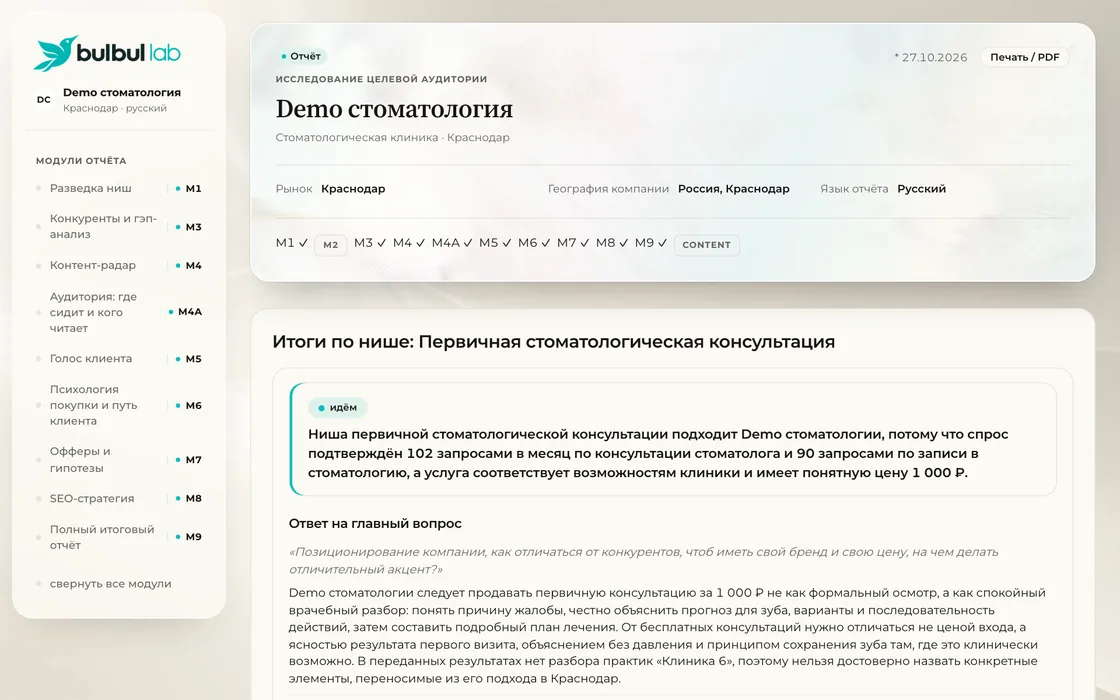
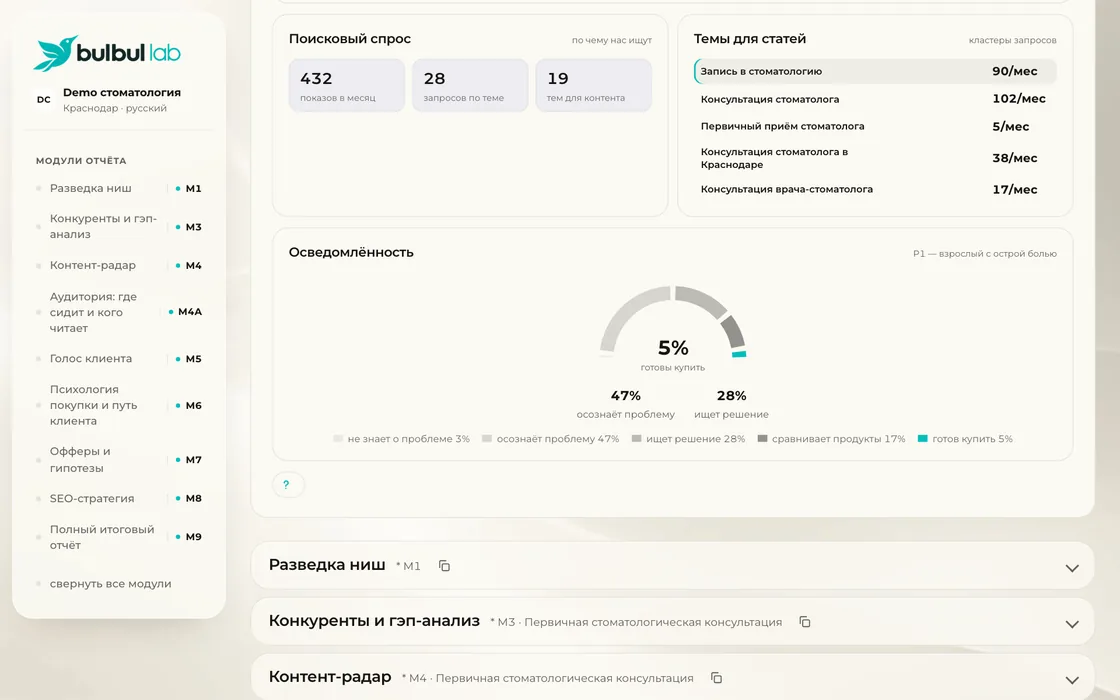
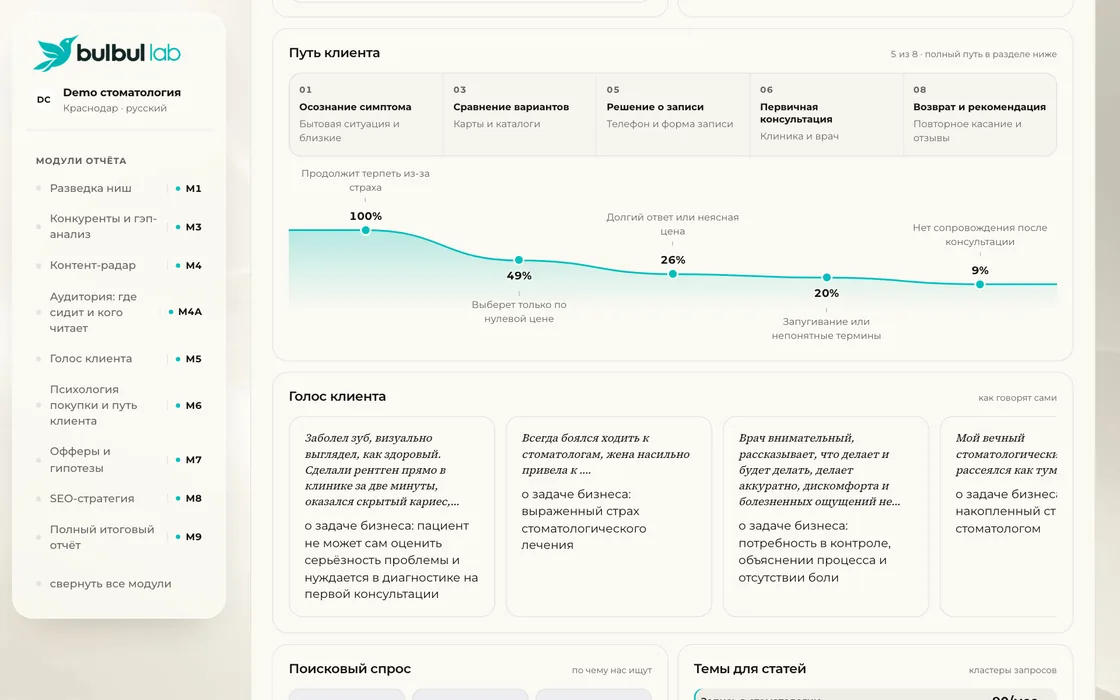
Research report page: demand, competitors and where the numbers come from
Research is the foundation of everything

We don’t “ask AI”. We measure the market

Ask AI and it answers from memory: averaged, without sources, with plausible but made-up numbers. Bulbul Lab collects and measures the live market, and AI only analyzes what has already been collected.

AI chatanswers from memoryBulbul Lab researchmeasures the market now
Where the data comes fromthe model’s memory, as of its training datelive search and page reading, right now
Demand“quite a lot” or made-up numberssearch volume from Yandex Wordstat and Google Ads for your city
Competitorswell-known namesthe ones your buyer finds, with prices from their websites
Voice of customergeneric “pain points”verbatim quotes, each linked to its source
Platforms“post on Telegram and Instagram”measured niche channels: followers, views, posting rhythm
How many customersno answernumber of companies in the niche, from registries and maps
Verificationnonea “where from” label on every number
ResultChat text with no way to check itA report via link and in PDF — the basis of your content plan

The scale of one niche

Numbers — from real runs.

hundreds

deep search queries

per niche — and each one reads the whole page, not a short snippet.

up to 600

channels measured by our code

Followers, views, posting frequency, post length. The largest ones go into the analysis — with their numbers already in.

25–40

competitors on the market map

Plus 5–8 at the same price level as you — analyzed in depth.

Where the research costs go

Most of the work is collecting and measuring, not writing text. Measured cost of one niche.

9 + summary

sections for each niche

Plus an overall report on all niches and a short executive summary.

7 connected services, 6 social networks we measure ourselves, government registries — and only then AI

7connected services
  • Yandex Wordstatdemand
  • Google Adsdemand
  • Google Mapscompanies on the map
  • Web searchlive pages
  • Public profile collectionInstagram and TikTok
  • Yandex Metrica and Directif you connect them
  • AI modelsanalysis of what’s collected
6platforms where our code collects the numbers
  • Telegramchannels
  • YouTubechannels
  • VKcommunities
  • Dzenchannels
  • Instagrampublic profiles
  • TikTokpublic profiles

We add new platforms as soon as we get access to them.

8metrics for every channel
  • Followers
  • Viewsmedian
  • Engagement
  • Posting frequency
  • Posting times and days
  • Post length
  • Formatsvideo, photo, polls, text
  • Amount of content
Open data: Federal Tax Service business registries, ministry licenses, industry associations, the central bank rate for prices in a foreign currency.Your data — optional: a CRM file is processed right in your browser, and only summary numbers are saved.
What you’ll learn

Nine sections about your market — and a summary

The sections go in order and build on each other: each one uses the conclusions of the ones before it. That’s why the research goes through all of them — for each niche separately. Choose a section to see what’s in it and what it’s built on. At the end — the niche summary: the whole niche on one screen, first steps and a direct answer to your main question.

00

Brand profile

You enter your website address — the service reads the site and builds the brief itself.

You’ll learn

  • Services, prices, about the company — from your website
  • Logo, colors, fonts — for the report and content
  • Main question for the research — the summary answers it separately
  • Benchmarks — who you look up to, even from another city

What it’s built on

Your website. Optionally — audience gender and age from Yandex Metrica and Direct, and a customer summary from a CRM file: the file is processed right in your browser, and personal data doesn’t go anywhere.

your-site.comread
Services · 14Prices from the siteAbout the companyLogoColorsFonts
Main question for the researchHow do we stand out from the big schools?
We only ask what isn’t on the siteHow do you make money?Who do you look up to?
Why you can trust this data

Every number has a source

That’s what sets the research apart from AI-written text: everything in the report can be checked.

1,240queries per monthYandex Wordstat · your city

Our code collects the numbers

Search volume, followers, views and the number of companies are taken from the source as is — AI doesn’t rewrite them.

search queries69
links found1,085
unique pages959
pages analyzed289
one section of one niche · and there are nine sections

Under every block — “Where the numbers come from”

The “Sources” section shows how much was found, how much was read and how much went into the analysis.

“Called three places — none of them named a price”

found on the page · reviews

Quotes are verified

Every customer quote is checked against the page it came from. Unverified quotes are marked, and old ones are marked with their age.

“Doctor”not measured · the name is a common word

A common word is not a brand

If a competitor’s name matches a common word, people searching for that word aren’t looking for that company. Such names don’t count toward recognition share.

the source gave no monthly numbers

No data — and the report says so

We don’t draw spikes that aren’t there. If a search didn’t work, the report says so plainly instead of claiming “the niche is empty”.

waiting for youChoose niches to analyze
Take onLater

The decisions are yours

Which niches to take, which search phrases to measure, what personality your brand has — the research stops and asks.

Why you need the report

Every finding is a ready action

The report isn’t for the shelf: every number in it changes something in your business. Here are four findings from a real report of a dental clinic (name hidden): the number from the measurement, what it means and what to do about it.

01

People search for a doctor, not a service

“pediatric orthodontist”
482
“bite correction”
10
queries per month

Meaning: parents look for a specialist, not a procedure.

What to doA “Pediatric orthodontist in Krasnodar” page — with the doctor, the address and the consultation price, rather than a “bite correction” service page.

02

They want to see the price before calling

queries about implant prices
369
queries per month

Meaning: people compare costs before booking.

What to doPut the consultation price on the first screen of the website and in the booking form.

03

Nobody searches for the clinic by name

market leader by name
2 319
client’s clinic by name
a handful
queries per month

Meaning: people won’t come by name but through searches for the service.

What to doInvest in pages and articles for service queries, and build brand awareness separately.

04

The biggest niche isn’t always the best way in

dental implants uncertain
7 012
initial consultation go
432
queries per month and the report’s verdict

Meaning: demand volume isn’t the only criterion: competition, economics and fit with the clinic matter too.

What to doStart with the niche where the verdict is “go”, even if it has less demand.

The research goal is set in advance

The brief has a “Main question for the research” field. If you fill it in, all sections work toward the answer, and the niche summary gets a separate “Answer to the main question” block — the answer and the principles it rests on.

The more precise the question, the more targeted the conclusions. The sample has such a block: the clinic asked how to differ from competitors so it could have its own brand and its own price.

Main question for the researchHow do we differ from competitors so we can have our own brand and our own price?Other examples: how to stand out from competitors, what to emphasize to hold our price.
BenchmarksWho you look up to — even from another cityThe research will show which of their practices carry over to your market.
Who to compare us withCompanies of your scaleA small company doesn’t need to be compared with giants.
Who it’s for

Who research is for

Eight types of business that research fits fully. Here are the most common — the full list, including who it fits partly and who it doesn’t, is in the answer below.

  • Dental clinic
  • Beauty salon
  • Apartment renovation
  • Real estate
  • Psychologist
  • Lawyer
  • Online school
  • Mobile app
  • CRM and business software
  • Marketing agency
  • Accounting
  • Manufacturing and supply
Sample report

Get a real niche report

Three questions about your business — and you’ll see a sample of a full report on one niche. It’s a real report for a dental clinic in Krasnodar, name hidden.

No phone or email needed. Our Telegram bot will send the full report — we’re connecting it very soon.

Question 1 of 3

What do you sell?

Questions and answers

Questions about research

How is this different from asking ChatGPT?

A chat answers from the model’s memory — as of its training date, averaged and without sources; the numbers in such an answer are often made up. Bulbul Lab goes to the live market right now: it reads hundreds of pages — competitor websites and price lists, reviews, discussions — measures demand in Yandex Wordstat for your city and in Google Ads for your country, counts companies in registries and on Google Maps, and collects channel numbers.

AI only analyzes what has already been collected and measured. About 85% of research costs go to collecting and measuring data, about 15% — to AI.

Which businesses is research for?

Fits

  • Local services by appointment — dental practices and clinics, beauty salons, barbershops, fitness, massage, car services, appliance repair, vet clinics, children’s centers, driving schools
  • High-ticket services with a long choice — apartment renovation and interior design, house building, real estate, weddings, tours
  • Expert consultations — psychologists, coaches, tarot readers, astrologers, BaZi, feng shui, nutritionists, stylists, lawyers and financial advisers for individuals
  • Online education — online schools, courses, challenges, subscription clubs
  • Online services and apps for people — online readings and calculators, health and habit apps
  • Subscription services for business — CRM, widgets, analytics
  • Services for business — marketers and agencies, development, design, accounting, lawyers and recruitment agencies for business, consulting, staff training
  • Suppliers and manufacturers for companies — raw materials, equipment, packaging, feed additives, wholesale

Partly fits

  • Cafés, restaurants, neighborhood shops — competitor and map review analysis fits. The buyer’s decision is spontaneous, funnels are hardly needed.
  • Products for people (clothing, cosmetics, home goods) — audience and review analysis fits. There is no marketplace analytics.
  • Industry and tenders — competitor analysis fits. People buy through tenders and connections; there are almost no public reviews or demand data.
  • Foundations and charity — audience analysis fits. There is no price and no purchase.

Doesn’t fit

  • Selling only through a marketplace, when the question is “what to sell and at what price”.
  • Advertising banned or strictly limited by law: tobacco, alcohol, prescription drugs, gambling. Research is possible, promoting with content is not.
Where does the data come from?

7 connected services: web search, AI models, Yandex Wordstat, Google Ads, Google Maps, public Instagram and TikTok profile collection, Yandex Metrica and Direct — if you connect them.

6 social networks we measure ourselves: Telegram, YouTube, VK, Dzen, Instagram, TikTok. Each channel has 8 metrics: followers, views (the median, so one viral post doesn’t distort the picture), engagement, posting frequency, posting times and days, post length, formats, amount of content.

Open data: government and industry business registries, licenses, industry associations, the central bank rate for prices in another currency.

How much data is collected per niche?

Hundreds of search queries and up to 600 measured channels. An example of one section — “Audience” for a dental niche: 69 search queries → 1,085 links → 959 unique pages → 289 pages analyzed; 82 channels and 28 search phrases measured. And that’s one section out of nine.

The market map has 25–40 competitors. 5–8 of them are analyzed in depth — the ones at your price level.

Can I check the conclusions?

Yes. Under every block of the report it says where the numbers come from. Our code takes the numbers straight from the source — AI doesn’t rewrite them.

Every customer quote has a link to its page, and the quote is checked against that page. The report shows how many quotes passed the check and from how many different sites the voice of customer was collected; old quotes are marked with their age.

Where there’s no data, the report says so: no spikes are drawn in. If a search didn’t work, the report says so plainly instead of claiming “the market is empty”.

What do I need to get started?

Your website address. The service reads your services, prices, logo and colors on its own and asks only for what isn’t on the site. You can set a main question for the research — for example, “how to stand out from competitors” — and the summary will answer it in a separate block. You can name benchmark companies, even from another city: the research will show which of their practices carry over to your market.

You don’t need to know marketing. Where your decision is needed — which niches to take, which search phrases to measure, what personality your brand has — the research stops and asks. The run happens on the server: you can close the tab, and the top of the screen shows which section and which niche are in progress right now.

Why is each niche a separate report?

Different niches have different buyers, competitors and queries: people search for an initial consultation and for implants at the same clinic in different ways. That’s why each selected niche goes through all nine sections separately. The sections build on each other, so we don’t skip any: without the first ones, the picture would be incomplete.

On top of that — an overall report on all niches and a short executive summary.

What do I actually get?

A report via link: it opens without signing in or registering, and you can revoke the link. Right in the report, you mark what you’re taking on. There’s a report for each niche, an overall report for all niches, an executive summary, a print version and a book-style PDF. After a new run, the report at the same link updates itself.

And it’s not a report that sits in a drawer: your content plan, platforms, topics, offers and funnel are built on it.

Can I add my own data?

Yes, if you want. Audience gender and age — from Yandex Metrica and Direct. A customer summary — from a CRM file: it’s processed right in your browser, personal data doesn’t go anywhere, and only summary numbers are saved. You can upload your own semantic core as a file from Key Collector, Keys.so or Ahrefs.

Where are my customers’ contacts stored?

With you. Leads go straight to you — we don’t store your customers’ contacts.

Which markets does it work in?

Russia, Turkey, the Gulf countries — each market has its own set of platforms. The market and the research language are chosen separately, and competitor prices are converted into one currency at the central bank rate.

How much does it cost?

We’ll publish pricing soon. Before each run, the service shows the estimated cost of the research.

Know your market in numbers

Start by researching your niche: how many customers you have, who your competitors are and how well-known they are, what words your buyer uses — with a source under every conclusion.

Start research